UPCOMING EVENTS: Healthcare Revenue Cycle Webinars
Join Sabrina for healthcare revenue cycle webinars and live talks by registering below.
SEPTEMBER 27, 2026 • 1 PM CST
How to Anticipate and Prepare for a RAC Audit-Top 10 Ways to Ensure Compliance and Mitigate Risk
Presented by HBMA
Unfortunately, audits have become a way of life for medical practices. Compliance issues for providers should always be a priority. The talk is intended to provide a roadmap to assist providers in identifying risks that make them vulnerable to RAC (Recovery Audit Contractor) audits and to educate them on ways to prepare for and anticipate RAC audits.
RAC auditors are paid on a contingency basis calculated on the overpayment amounts they recover. The size of the overpayment can be significant if the RAC findings are extrapolated and the overpayment is calculated on that basis.
While the revenue cycle team works at getting claims paid, it also must focus on how to keep those payments from being recouped. The talk will cover common RAC audit findings, how the audit process works, and what steps to take in the event of a RAC audit results in an overpayment letter. Finally, we’ll address preventative measures a practice can take to mitigate the risk of an audit.
REGISTER HERE
Key takeaways:
- What is a RAC audit and how does the RAC select providers for audit?
- New CMS approved RAC audit topics
- Medical Reviewer Guidelines for coding and medical necessity reviews
- Common RAC audit findings
- The RAC audit documentation request (ADR) process and how to prepare a response to an ADR
- The consequences of missing the ADR deadline
- Strategies for contesting the extrapolation of the RAC calculation of the overpayment
- Next steps after an overpayment letter is received—how to evaluate your position and options available prior to an appeal
- The appeal process to RAC overpayment audit findings
- Preventative measures to avoid RAC audits
November 11, 2026 • 1 PM CST
Downcoding: A Payer Trend and How to Protect Practice Revenue
Presented by HMBA
Free for HMBA members!
The health of many independent practices is tied to the reimbursement of their E/M codes (99202-99205, 99212-99215). The trend among payers to downcode these services has an impact on independent physician practices, though its significance may be undetected because practices do not know how to identify and track patterns in downcoded services.
Practices must have a plan in place to anticipate and respond to automated payer adjustments. The talk will outline steps to improve a practice’s billing processes to avoid lost revenue due to downcoding of E/M codes and to standardize an appeal process to expedite the recapture of lost revenue. The talk offers practical advice for all members of the revenue cycle team and providers.
Downcoding is a financial strategy that practices are on the losing side of—the extent of practices’ loss is difficult to calculate because it takes the form of an adjustment.
This, coupled with the high labor cost for appealing claims, makes aggressively fighting downcoding of E/M services difficult. Billers for small practices are already stretched thin—with claims submission and working denials, making filing appeals of downcoded claims difficult. It’s hard to calculate practice loss, because the adjustments may take the form of an E/M code change requiring review of the claim and the EOB to see what was paid, or it could take the form of a payment adjustment, requiring review of the allowed amount on the EOB, comparing it to the contract rate of each claims.
Participants will learn how to identify the specifics of payer downcoding policies, and how to identify patterns in EOBs indicative of downcoding of E/M claims. This will focus efforts to appeal downcoded claims, but cannot address the loss of revenue due to non appealable claims when downcoding was justified. The second half of the talk will focus on preventative measures—through provider education, ensure that clinical documentation of E/M elements is provided.
REGISTER HERE
Course participants will be able to:
- How to identify trends in payer downcoding of E/M codes—the specifics of major payer policies
- How to track payment variances through use of EOBs to identify downcoded claims
- How to identify patterns in payer adjustment reason codes in Level 4 and 5 downcoding
- Ways to identify providers in your practice with a high percentage of E/M adjusted reimbursements
- Ways to recapture practice revenue through standardizing appeal processes
- Methods for expediting appeals using AMA appeal template letters
- Guidance to physicians on proper documentation of E/M elements: problems addressed, data reviewed and risk.
- The importance of capturing all diagnoses treated to capture MDM complexity
- Where the disconnect between physician documentation and coding can lead to a gap in medical necessity required to support the claim
December 4, 2026 • 1 PM CST
Key Strategies for Negotiating Payor Contracts
Presented by HMBA
Many providers believe they have no leverage to negotiate a contract and the idea of directly contracting is inconceivable. The analysis for negotiating higher rates is data driven, but it is sensitive to the uniqueness of a practice, the population it serves, the number of specialists in that community served, and the quality of care offered by the provider.
A successful negotiation begins long before you sit down with the payer. You need to know your payer contracts and identify where your reimbursements may not cover your costs. Know your numbers—understand your breakeven point, your payer mix and your top CPT codes that make up the highest percentage of revenue. Identify those contracts to prioritize. By preparing you make certain you don’t leave money on the table—this talk provides the guidance as to how to marshal your arguments to obtain higher negotiated rates.
REGISTER HERE
Course participants will be able to:
- How to calculate their breakeven point;
- How to review your payer mix to prioritize specific payer contracts
- Benchmarking against Medicare against other payers
- How to use purchased data to evaluate competitor’s rates and benchmark against those competitors
- The use of MIPS data to establish a value based argument
- How to use MGMA data to track provider productivity
- Way to calculate market share
- Written terms that should be in every negotiated contracts
SEPTEMBER 21, 2026 • 12 PM CST
Negotiating ASC Contracts
AAPC and PAHCOM approved 1.0 CEU
Strategies for Negotiating ASC Contracts
Negotiating payer contracts is one of the most important decisions an ambulatory surgical center can make. Yet, effective negotiations involve much more than asking for higher rates.
This presentation provides a practical introduction to ASC payer negotiations with a focus on the key issues that influence reimbursement and the financial performance of an ASC. Attendees will learn how to prepare for negotiation, evaluate current payer contracts, identify opportunities for improved reimbursement, and determine which rates and contract provisions should receive the greatest attention. Topics will include understanding an ASC’s payer mix, and costs, evaluating current reimbursement, identifying top CPT codes, addressing contract language that affect payment and developing an effective negotiation plan.
Key takeaways:
- Understanding the fundamentals of ASC reimbursement
- Identify the financial information needed before entering negotiations
- Determine which procedures and reimbursement rates should be prioritized
- Recognize contract provisions that can significantly affect ASC revenue
- Develop a practical strategy for negotiating with payers
- Common mistakes that can weaken an ASC’s negotiating position
REGISTER HERE
Sabrina Skeldon is the owner of Physician Practice Guidance, a consulting firm that provides revenue cycle services to small and medium size practices. She is a healthcare attorney, certified medical coder, medical auditor and certified medical biller. She has over 20 years of experience in the healthcare industry. She is a physician educator and has assisted many medical practices in physician office compliance, medical chart audits and provider and staff education. She will offer practical advice on how to fight the automated payer downcoding of E/M services.
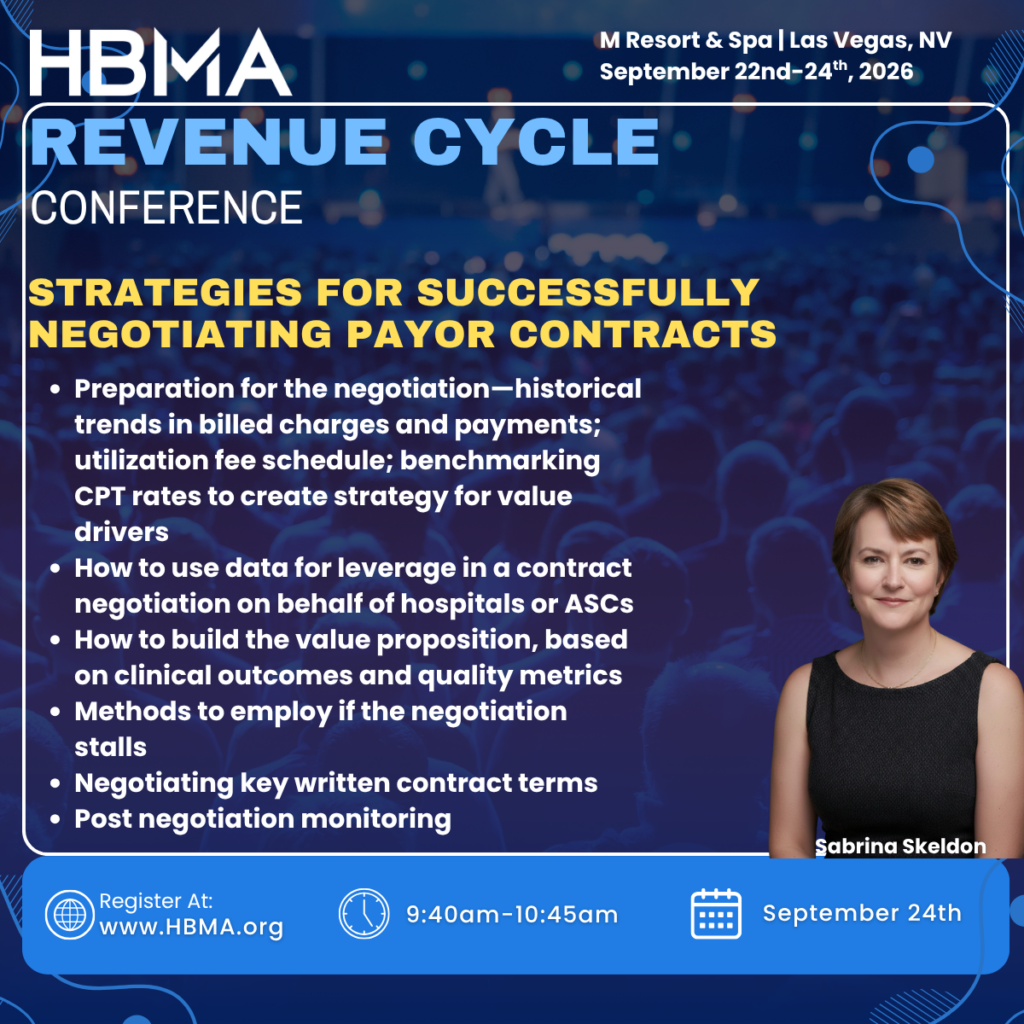
Sept 24, 2026
Live in Vegas At HBmA
Strategies for successfully Negotiating payer contracts